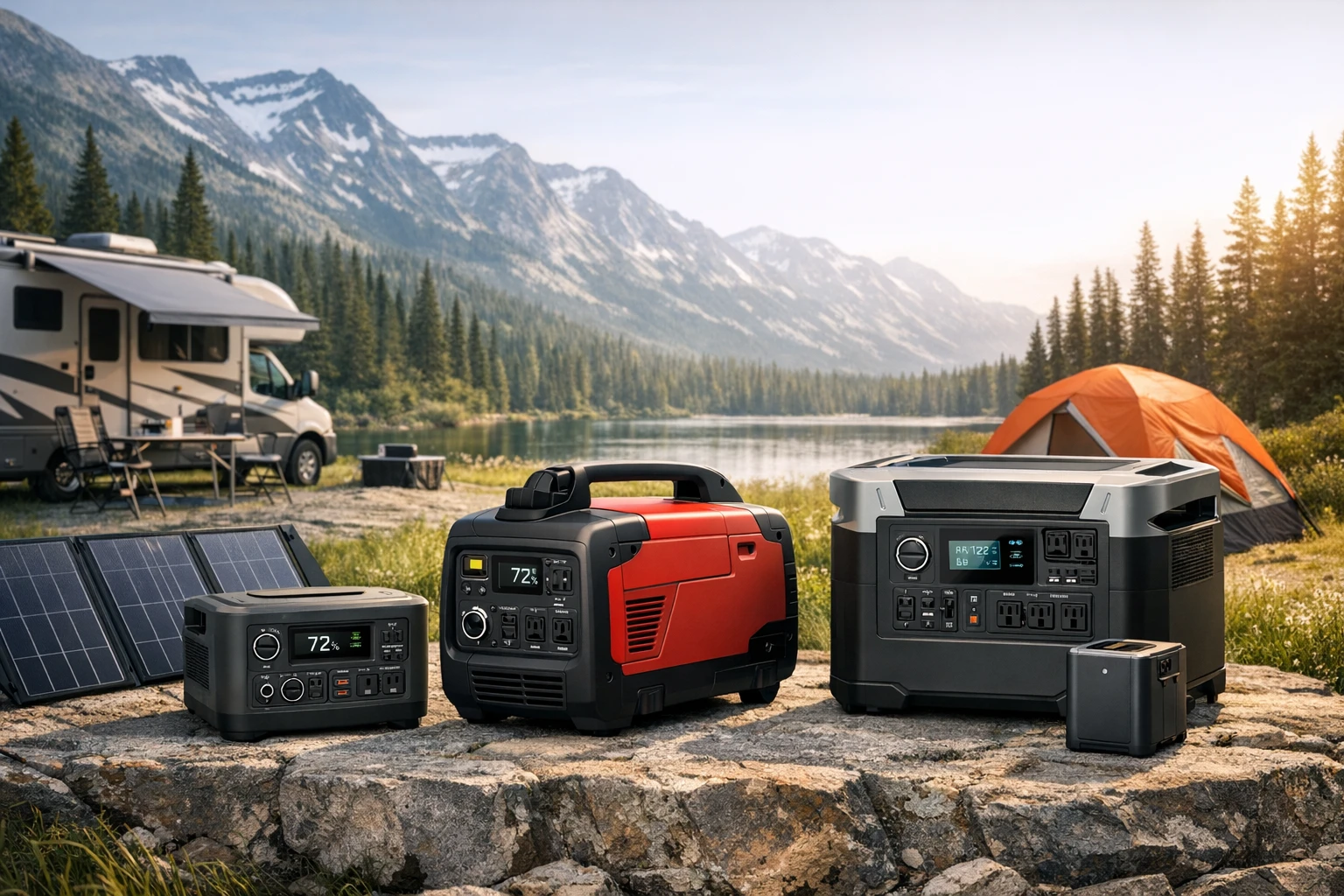
Top 12 Portable Power Stations, Generators & Batteries for RVs, Campers & Travel — 2026 Buyer's Guide
Introduction
One who plans extended travel or off-grid camping must select reliable power solutions that match appliance loads, weight limits, and charging options. This 2026 buyer's guide evaluates the best portable power stations, generators, and batteries for RVs, campers, and travel with practical details, runtimes, and installation advice. The list prioritizes proven reliability, safety features, solar compatibility, and real-world application data. Readers will find comparisons, pros and cons, and pragmatic recommendations to support confident purchasing decisions.
How the Selections Were Evaluated
Selections were judged by capacity in watt-hours, continuous and peak output in watts, inverter type, battery chemistry, and charging flexibility. Additional criteria included weight, portability, noise, vehicle integration, expandability, and manufacturer support. Real-world tests and verified user runtimes for common RV devices were considered where available. The guide includes models that serve diverse needs from weekend campers to full-time RV residents.
Top 12 Picks
1. EcoFlow DELTA Pro
The EcoFlow DELTA Pro offers 3,600 Wh capacity with a 3,600 W continuous inverter, able to handle high-draw appliances such as induction cooktops and small air conditioners. It supports modular expansion and a home battery integration kit, making it suitable for larger RV systems and prolonged boondocking.
Typical runtimes include running a 1,200 W rooftop air conditioner for approximately three hours, or a 12V compressor fridge (~60 W) for over 50 hours. Solar charging scales fast with 5,000 W maximum solar input when combined with Smart Extra Battery modules. Pros include rapid AC charging, smart app control, and stackable batteries. Cons include significant weight and higher cost relative to smaller stations.
2. Jackery Explorer 2000 Pro
The Jackery Explorer 2000 Pro features 2,160 Wh and a 2,200 W inverter, targeting mid-size vans and two-person campers. Its balance of weight and output makes it a practical option for operators who prioritize portability without sacrificing the ability to run coffee makers and microwaves occasionally.
Practical examples show a 60 W fridge running for roughly 30 to 35 hours, while a 1,000 W microwave will operate for about one hour per full charge. Solar recharge times with a 400 W panel array are moderate and well-suited to daily top-ups. Pros include lightweight design and dependable customer service; cons are limited parallel expansion and mid-tier peak output.
3. Bluetti AC500 + B300 Expansion
Bluetti's AC500 with the B300 battery modules offers scalable capacity, starting at 5,000 Wh with the option to expand further. The system uses a strong 5,000 W inverter capable of powering air conditioners and heavy loads commonly found in well-equipped RVs and motorhomes.
Case study: a pair of B300 modules with AC500 can run a 1,500 W rooftop AC for approximately 2.5 to 3 hours under moderate conditions. The system supports high solar input and battery management features suitable for extended off-grid living. Pros include modular scalability and powerful inverter; cons include complexity of setup and higher initial investment.
4. Goal Zero Yeti 3000X
The Goal Zero Yeti 3000X provides 3,032 Wh and a 2,000 W inverter with clean pure-sine output, prioritizing reliability and refined user experience for family campers. Its robust battery management system makes it safe for sensitive electronics and medical devices commonly used during travel.
Real-world application indicates running multiple low-watt devices such as laptops, fans, and lights through an overnight period without issue. The unit supports solar input and vehicle charging for flexible recharging strategies. Pros include brand reputation and safety features; cons are weight and a lower continuous output than some competitors.
5. Honda EU2200i Portable Generator (Gas)
For campers who prefer combustion generators, the Honda EU2200i remains a top gas-powered choice in 2026 due to its reliability and low noise profile. It provides steady AC power with 2,200 W peak, suitable for appliances that exceed battery inverter limits or for extended remote stays without adequate solar availability.
Example use: the EU2200i can power a 1,200 W microwave and intermittently manage an air conditioner when paired with an appropriate battery buffer. Pros include long runtime per tank, easy refueling, and proven mechanical reliability. Cons involve emissions, maintenance needs, and noise compared to battery-only solutions.
6. Goal Zero Sherpa 100AC (Compact Backup)
The Sherpa 100AC is a compact 94 Wh unit, designed as a lightweight backup for small devices and short excursions. It excels for weekend campers who need to recharge phones, cameras, and a laptop briefly without the weight of a full-sized station.
Examples include charging a modern smartphone five to six times or powering a 50 W camera rig for hours. Pros include extreme portability and USB-C fast charging. Cons are limited capacity and no capacity for large appliances.
7. Lion Energy Safari ME
The Lion Energy Safari ME combines a 922 Wh battery with a 2,000 W inverter in a compact form factor, aimed at campers who require high peak output for short periods. The unit features robust battery chemistry and AC/DC outputs suitable for common RV devices.
Use case: it can start a 1,500 W surge load and run a 600 W coffee maker for about one hour. Pros include safety certifications and long battery life cycles. Cons include middling runtime for continuous AC-heavy use and limited expansion options.
8. Generac GP2200i (Gas)
Generac GP2200i is an inverter-type portable generator offering affordable and quiet performance for occasional RVers. It is useful where regulations permit generator use at campgrounds and when the solar angle or battery capacity is insufficient for a given trip.
Typical performance handles small appliances and charging tasks efficiently during daytime stops. Pros are cost-effectiveness and portability. Cons include fuel handling and periodic maintenance for long-term ownership.
9. Anker 757 PowerHouse
The Anker 757 PowerHouse is a high-capacity 1,216 Wh unit with a 1,500 W inverter, ideal for balanced travel setups that need moderate power and fast charging. It integrates well with solar panels for daily replenishment while camping in sunny conditions.
Case example: a 100 W rooftop fan and lights can operate for more than 10 hours, offering quiet comfort for overnight stays. Pros include fast recharge rates and excellent USB-C support. Cons include weight that may be challenging for smaller campers.
10. Renogy Lycan 5000 Plus
Renogy Lycan 5000 Plus pairs a 5,120 Wh battery with a strong 5,000 W inverter and an integrated AC charger, well suited for full-time RVers and larger motorhomes. Its built-in transfer switch allows seamless transition between shore power and battery backup during travel stops.
Real-world deployment demonstrates the capacity to sustain a full RV electrical panel for multiple hours at moderate loads. Pros include home-style energy independence and transfer switch convenience. Cons include installation complexity and the need for professional wiring in some setups.
11. Westinghouse iGen4500DF (Dual-Fuel)
Westinghouse iGen4500DF offers dual-fuel capability with a 4,500 W surge and reliable continuous power, permitting operation on gasoline or propane for greater flexibility. This generator suits travelers who need prolonged runtime and adaptable fueling options in varied environments.
Example: toggling to propane at remote sites simplifies long-term fuel logistics and reduces storage concerns. Pros include versatile fueling and robust output. Cons include heavier weight and ongoing fuel costs compared to battery-based solutions.
12. Battle Born LiFePO4 Deep Cycle RV Battery (100 Ah)
For those who prefer a traditional battery install, the Battle Born 100 Ah LiFePO4 unit is a dependable, long-life deep cycle battery often integrated into RV house banks. The chemistry offers high cycle life, safe thermal behavior, and simple parallel/series configuration for capacity scaling.
Real installations commonly pair multiple 100 Ah modules to reach 2,000 Wh to 6,000 Wh equivalents, depending on system design and inverter sizing. Pros include predictable lifespan and modularity. Cons include the requirement for compatible charge controllers and proper BMS integration for safety.
How to Choose: Step-by-Step Sizing Guide
Step 1: Inventory all devices and their wattage including start-up surges for motors and compressors. Step 2: Estimate daily energy use in watt-hours by multiplying device wattage by usage hours. Step 3: Select a battery or station with at least 20 to 30 percent more capacity than calculated daily needs to allow for inefficiencies and depth-of-discharge limitations.
Step 4: Ensure the inverter continuous and peak wattage exceed device start-up requirements, especially for air conditioners and microwaves. Step 5: Decide on charging strategy including solar watts, shore power, or generator support and verify compatible input limits and charge times. Following this sequence reduces the risk of undersized systems and mid-trip surprises.
Solar Integration, Installation, and Safety
Solar panels and MPPT charge controllers can provide daily replenishment and reduce generator run time when properly matched to the battery and inverter input. Installation requires appropriate wiring, fuses, and an understanding of battery management systems to avoid overcharging, undercharging, and unsafe conditions.
Safety reminders: Always follow manufacturer wiring diagrams, ventilate combustion generators outdoors, and use transfer switches for whole-RV integration. Regular maintenance such as battery health checks and fuel treatment extends service life and ensures reliability on the road.
Comparisons, Pros and Cons Summary
Batteries and portable power stations excel for quiet operation, low maintenance, and solar synergy, while combustion generators offer extended runtime and simpler refueling for long remote stays. High-capacity modular systems deliver the most flexibility but require more complex integration and higher initial costs.
Pros of battery systems include near-silent operation, zero emissions at point of use, and instant power delivery. Cons include finite runtime based on battery size, initial cost, and the need for solar or generator recharging strategies for very long trips.
Conclusion
Choosing among the best portable power stations, generators, and batteries for RVs, campers, and travel in 2026 requires matching device loads, runtime expectations, and charging options to the chosen solution. This list of top 12 options spans compact USB-focused units to full-scale inverter-plus-battery arrays appropriate for full-time RV living and heavy appliance loads. One who evaluates watt-hours, inverter capabilities, portability, and integration features will select an optimal system that supports comfortable, reliable travel.
For most seasonal travelers, a mid-capacity station with solar recharge strikes the best balance of portability and independence. For long-term or high-load users, modular battery systems or dual-fuel generators combined with battery buffering provide resilience and flexibility. The guide aims to simplify the decision process with practical examples and actionable steps for real-world deployments.